

Resonant Systems: Rethinking Social Capital and Cohesion
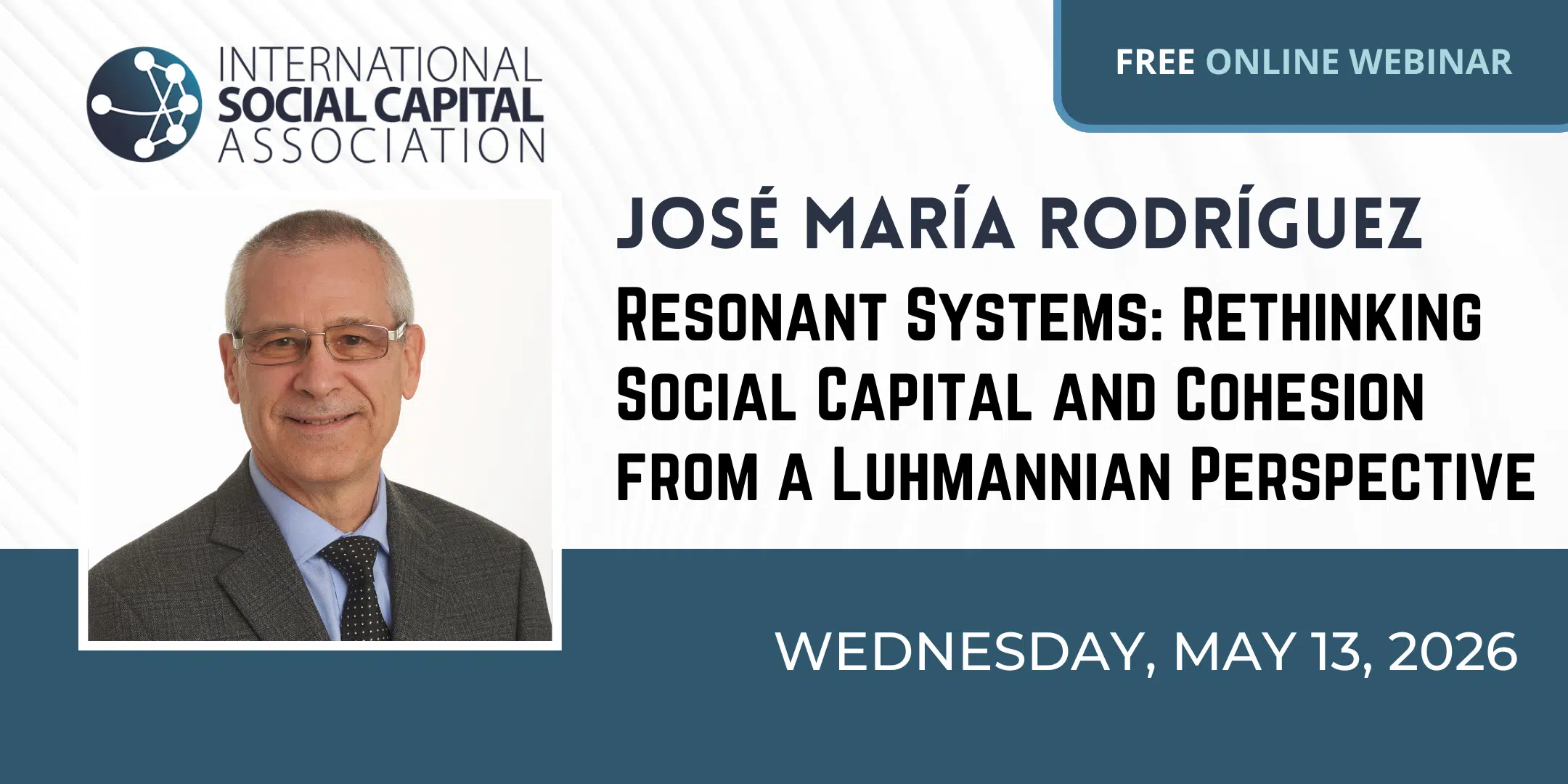
By José María Rodríguez and Segundo Vásquez
3P Consulting Engineers, Inc.
Our work seeks to explain how social cohesion is maintained in a modern, complex society that is assumed to be functionally differentiated into autonomous subsystems (economy, law, politics, science, etc.). To do so, we draw on advanced concepts such as resonance (Hartmut Rosa) and social capital (Simmel, Coleman, Putnam, Lin), focusing on the sociology of Niklas Luhmann: complexity, radical constructivism, functional dierentiation, autopoiesis (systems operate according to their own logic and are operationally closed but cognitively open), and self-referentiality.
Although from a strictly Luhmannian perspective (Social Systems Theory) society is composed of communication rather than persons, we introduce the concept of resonant social capital, reformulating the traditional notion of social capital (networks, trust) through the lens of Luhmannian Resonanzfähigkeit (capacity for resonance). In Luhmann’s framework, resonance refers to how autopoietic communication systems react to irritations (i.e., perturbations from the environment) without losing their operational closure. Referring to resonant systems—where a system’s internal communication can amplify or attenuate external influences—rather than simply social systems suggests a dynamic and contemporary approach to analyzing complex changes such as ecological crises or social transformations.
Our contribution is to articulate a systemic concept of social cohesion grounded in resonance rather than consensus. Against the traditional view based on moral agreement, our proposal argues that social cohesion emerges from the interdependence and structural coupling among autonomous subsystems. Systemic social cohesion is therefore understood as the capacity to maintain systemic identity and produce meaningful communication within a chaotic and polarized environment.
When applied to governance, to the mathematical topology underlying our theoretical framework, and to Popper’s model of gradual social change, the Adaptive and Intelligent Social Technology (AIS) offers a coherent analytical foundation for Salazar’s concept of the Citizen State. This foundation is rooted in Luhmann’s theory of functional differentiation.
José María Rodríguez is a professional engineer with over 45 years of engineering experience. He holds a Doctorate, a Master’s and a Bachelor’s degrees in Engineering from the University of New Brunswick in Fredericton, NB, Canada. He has been certified as a Project Management Professional (PMP) by the Project Management Institute (PMI) and is a member of the Association of Professional Engineers and Geoscientists of New Brunswick (APEGNB).
Over the last 25 years, Mr. Rodríguez has acted as a senior manager / planner on projects across Canada and in Venezuela. His experience includes nuclear facilities, waste management, industrial, infrastructure and high-technology applications.
Mr. Rodríguez is currently the Project Director of AIS Technology at 3P Consulting Engineers, Inc.