Welcome
Dear Esteemed Members and Colleagues
Welcome to the latest edition of The Bridge, the newsletter of the International Social Capital Association (ISCA). This edition reflects the depth of our shared inquiry and the growing reach of our global community of scholars, practitioners, and policymakers. The Bridge serves as a space to connect ideas, people, and practice, bringing together research, debate, and innovation in social capital.
In the pages that follow, you will find a curated selection of insights, updates, and recent accomplishments from across the ISCA network. These contributions highlight both theoretical advances and practical applications of social capital in diverse contexts. We hope this edition informs, inspires, and encourages continued dialogue and engagement within our community.
Download a PDF of this newsletter
Message from the President:

Across the world, concern about social fragmentation, loneliness, declining trust, and institutional strain is growing. At the same time, interest in social capital and human connection has never been more visible—or more urgent. It is in this context that Social Capital 2026 takes on particular significance, both for our Association and for the wider field.
Social Capital 2026 marks the first time in decades that the global social capital community has come together at this scale. Scholars, practitioners, policymakers, and organisational leaders will gather to reconnect strands of work that have too often developed in parallel. The response has been remarkable. We have accepted more than 400 abstracts, reflecting the depth, diversity, and vitality of work underway across regions, disciplines, and domains of practice. This level of engagement confirms a strong appetite not only to present work, but to listen, learn, and build shared understanding.

For ISCA, the conference represents a moment of convergence and renewed momentum. It brings into closer conversation the many ways social capital is being researched, understood, and applied around the world, while also sharpening the Association’s role as a convenor of that conversation. It creates space to think collectively about priorities, gaps, and opportunities, and about how ISCA can better support collaboration and learning beyond the conference itself.
One expression of this commitment is the evolving role of the ISCA newsletter. In addition to our own updates, we are intentionally including news and developments from across the broader human connection sector, including work on social connection, social cohesion, belonging, trust, wellbeing, community resilience, and civic life. Many organisations and initiatives are grappling with the same underlying challenges, even when they use different languages or frameworks. Strengthening awareness, engagement, and cooperation across this wider field is essential if we are to respond effectively to current and emerging societal challenges.
Over the past five years, ISCA’s webinar series has played a vital role in sustaining the global social capital community, especially during periods when in-person connection was not possible. These webinars have provided a regular space for exchange, debate, and relationship-building. As we prepare for Social Capital 2026, the webinar series will pause until after the conference. We are also actively considering changes to its format, informed by insights from the conference and by the evolving needs of our members.
Social Capital 2026 is ultimately about more than a single event. It is about strengthening connections across a diverse field, encouraging collaboration rather than fragmentation, and positioning social capital and the wider human connection sector to contribute more effectively to the challenges of our time.
Tristan Claridge
President, International Social Capital Association
Conference highlights
Early-bird registration rate for the conference closes on 23 January.
A reminder that early-bird registration for Social Capital 2026 closes on 23 January. Reduced rates are available for a limited time, offering a valuable opportunity to secure a place at the conference while benefiting from discounted registration. With strong interest already evident, we encourage participants to register early and take advantage of the early-bird rate before it expires.
Connection Ambassadors Workshop at Social Capital 2026
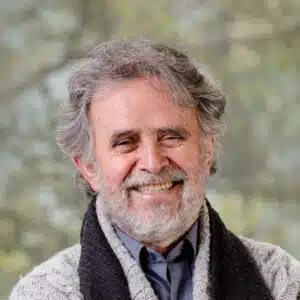 As part of its commitment to creating social capital—not just discussing it—Social Capital 2026 will include a small, invitation-only Connection Ambassadors Workshop held ahead of the main conference. This intensive, four-hour experience prepares a select group of around 30 participants to actively support meaningful connection throughout the event, helping ensure that the conference’s relational potential is fully realised.
Grounded in Conversational Constructivism developed at the University of Chile, the workshop equips participants with simple but powerful conversational and relational tools, including self-awareness, emotional presence, deep listening, and more intentional forms of engagement. During the conference, Connection Ambassadors will be identifiable by a special name tag and will serve as warm, approachable “connection builders”—welcoming newcomers, bridging disciplines and cultures, and modelling open, respectful conversation across the event.
Facilitated by Professor Carlos Vignolo, whose work spans organisational transformation, social capital building, and applied constructivist practice, the workshop blends conceptual grounding with highly interactive individual, group, and plenary exercises. Together, these ambassadors form a light but powerful relational infrastructure, helping Social Capital 2026 become not only an intellectual gathering but a lived demonstration of social capital in action.
Screening of Join or Die at Social Capital 2026
 This Emmy-nominated feature documentary follows the legendary social scientist Robert Putnam’s groundbreaking “Bowling Alone” research into America’s decades-long decline in community connections, which could hold the answers to our democracy’s present crisis. The documentary includes influential fans and scholars from Pete Buttigieg, Surgeon General Vivek Murthy, to Jane McAlevey, Hillary Clinton, and Eddie Glaude Jr. It documents inspiring groups building communities in neighborhoods across the country as Bob explores three urgent civic questions: What makes democracy work? Why is American democracy in crisis? And, most importantly… What can we do about it?
Keynote Speakers at Social Capital 2026
Social Capital 2026 brings together some of the world’s most influential thinkers to examine how trust, networks, and social relationships shape resilient and prosperous societies. Our keynote speakers are internationally recognised for their pioneering research and real-world impact, and together they offer a rare opportunity to engage with diverse, cutting-edge perspectives on social capital.
 We are delighted to announce three keynote speakers whose work has fundamentally shaped contemporary understanding of community, opportunity, and social structure. Robert D. Putnam, Malkin Research Professor of Public Policy at Harvard University, is one of the most widely cited social scientists of the past century. Renowned for landmark works such as Making Democracy Work and Bowling Alone, his research has influenced public policy across the world and earned him the National Humanities Medal.
 Joining him is Raj Chetty, William A. Ackman Professor of Economics at Harvard University and Director of Opportunity Insights. A leading figure in the use of big data to understand economic mobility, Chetty’s work has transformed how scholars and policymakers think about opportunity, inequality, and the social conditions that enable people to thrive. His contributions have been recognised with awards including the MacArthur Fellowship and the John Bates Clark Medal.
 Completing the keynote trio is Beate Völker, Professor of Sociology at VU Amsterdam and Scientific Director of the Netherlands Institute for the Study of Crime and Law Enforcement. Her research on social networks, neighbourhoods, and social cohesion has provided critical insights into how social capital is shaped by institutional and urban contexts, and how these structures influence well-being and societal stability.
Together, these keynote speakers will offer fresh insights, challenge assumptions, and set the intellectual tone for a conference that aims not only to analyse social capital, but to advance how it is understood and applied in practice.
Join Social Capital 2026 Virtually
Can’t make it to Dubai? You can still be part of Social Capital 2026 through our virtual participation option. While we strongly encourage in-person attendance for the fullest conference experience, we recognise that travel is not possible for everyone.
Virtual delegates will take part in dedicated online sessions on Wednesday, 25 March 2026, the day before the main conference, and will receive on-demand access to recordings of all three keynote presentations. At this stage, the main in-person program will not be available to virtual participants.
Interested in presenting your work? Submit an abstract and select the virtual option. Accepted presenters will present live on Zoom and engage with an international audience in real time.
Featured member
For this edition, we sat down with Professor Dame Heather McGregor to get her insights.
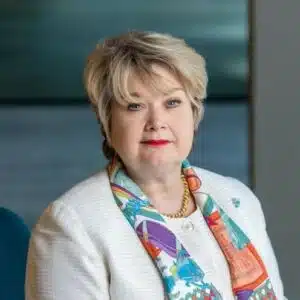 ISCA: What is your background, and how did your work come to focus on social capital and leadership?
Heather: My career has moved across finance, entrepreneurship, and higher education, which has given me a practical understanding of how organisations function beyond formal structures. Early work in investment banking, followed by many years running my own executive search firm, made it clear that outcomes are shaped as much by trust, influence, and informal networks as by strategy or systems.
When I later moved into academic leadership, those same dynamics were visible at an institutional level. Work in governance, leadership development, and gender equity repeatedly highlighted that performance, resilience, and change depend heavily on the quality of relationships within organisations. This naturally led my work to focus on social capital as a way of understanding how institutions and communities sustain themselves and adapt over time.
ISCA: How do the ideas of social capital inform your work as a researcher, leader, and conference convenor?
Heather: I see social capital as the underlying infrastructure that enables collaboration and collective problem-solving. Trust, shared norms, and networks allow ideas to circulate, partnerships to form, and disagreement to be handled productively.
That perspective has shaped the design of the Social Capital conference in Dubai. The programme combines leading research with opportunities for shared reflection and interaction. This includes keynote contributions from internationally recognised scholars such as Robert D. Putnam, whose work has been foundational to how we understand social capital, alongside Raj Chetty and Beate Völker, whose research explores inequality, opportunity, networks, and social structure from different empirical and sociological perspectives. Together, their work reflects the breadth and depth of contemporary social capital research.
ISCA: Why is the Social Capital conference important at this moment?
Heather: We are operating in a period characterised by uncertainty, institutional strain, and increasing social fragmentation. Questions about trust, civic participation, and social cohesion are no longer abstract, they are central to how societies function.
The Social Capital conference brings together researchers, practitioners, and policymakers who are engaging with these issues from different angles. Hosting the conference in Dubai underscores the global relevance of these conversations and creates space for international and cross-cultural exchange. Alongside keynote presentations, the programme encourages dialogue through interactive formats, including the Connection Ambassadors Workshop, which focuses on practical approaches to strengthening connection and collaboration.
ISCA: What do you hope participants take away from the conference?
Heather: I hope participants leave with both new insights and new relationships. Social capital research is inherently interdisciplinary, and many of the most valuable ideas emerge through conversation rather than presentation alone.
Shared experiences play an important role in this. The screening of Join or Die, which draws directly on the work of Robert Putnam, provides a powerful entry point into discussions about declining social connection, civic engagement, and community life. Whether attending in person in Dubai or through the Virtual day on the 25th of March, I hope participants come away with ideas they can apply in their own contexts, and with connections that continue beyond the conference itself.
Recent webinars
Our recent webinars have brought together leading scholars and practitioners from around the world to explore new perspectives on social capital, including its theory, measurement, and practical application across diverse contexts. Below you’ll find the latest recordings, each offering valuable insights and examples of how social capital shapes our societies, organisations, and communities.
Toward a Unified Conceptualization of Social Capital
Jimi Adams | 12 November 2025
https://youtu.be/0HGhgUAf9dk
Building Social Capital by Design
Geeta Mehta & Sushmita Shekar | November 19, 2025
https://youtu.be/MKGhlZKEJDM
The monetary value of social capital in post-disaster contexts: Evidence from Australia
Bridget Tehan & Aaron Nicholas | November 26, 2025
https://youtu.be/d5g4mquZ9w8
Weaving Webs of Relationships: Supporting Youth Success Through Social Capital
Michael Wright | December 3, 2025
https://youtu.be/vPFXjAcNhBI
From Relationships to Resources: Fostering Social Capital Through Positive Youth Development
Heather Poparad & Ashley Boat | December 10, 2025
https://youtu.be/i5y8R7V5Eic
Engineering and Social Capital- An Innovative Look at Building Disaster Resilience
Dr. Arif Sadri & Dr. Jeff Donaldson | January 7, 2026
https://youtube.com/live/mWH90NqjBbc
Connections to Careers: How Social Capital Accelerates Progress
Professor Dame Heather McGregor | January 14, 2026
https://youtu.be/rmT6EHhIkkE
View more on our YouTube channel
https://www.youtube.com/channel/UC6NOu8v0Oe8xaLn4UK9s36g/
Don’t forget to subscribe and click the bell icon to get notifications about new videos.
News from Our Network:
USA Chamber of Connection
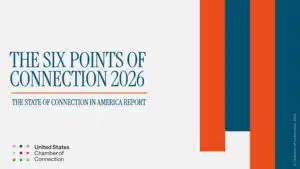 USA Chamber of Connection has just released their first annual report entitled “The six Points of Connection 2026: The State of connections in the America” report.
This report reveals where everyday social connection is breaking down — and introduces a practical, data-backed blueprint.
You can read the Report here https://www.chamberofconnection.org/the-six-points-of-connection-2026
RSA US
RETHINKING CARE, CONNECTION, AND LEADERSHIP USING THE FEMINIST IMAGINATION (Virtual)
Jan 22 @ 8am-9am PT I 11am-12pm ET I 4pm-5pm GMT
Join RSA’s Gender Equity Network for an invitational online salon exploring joyful, inclusive approaches to leadership, care, and community building through a feminist lens with author and Gender Equity Network co-lead Jessica Aviva, PhD, FRSA. This virtual gathering offers an open space to connect, reflect, and reimagine how care and connection can shape more equitable and connected communities.
REGISTER HERE
TRACKING CONNECTION, STRENGTHENING COMMUNITIES: A 25-YEAR SURVEY (Virtual)
Feb 11 @ 9am-10am PT I 12pm-1pm ET I 5pm-6pm GMT
Join RSA US and Social Connection in America for a live conversation with Dr. Julianne Holt-Lunstad to explore new national data on social connection, reflect together, and connect with others working to build belonging, trust, and stronger communities.
REGISTER HERE
The Foundation for Social Connection
Roadmap for Building Economic Mobility Through Social Capital
The Foundation for Social Connection has launched The Roadmap: Reimagining Infrastructure to Improve Social Capital – a guide for local governments, community organizations, and residents alike to leverage the power of social connection in local infrastructure decisions to advance economic mobility. The Roadmap presents six principles and practical strategies to:
- Empower local governments to design policies and investments that prioritize relationship-building and belonging
- Strengthen partnerships across socioeconomic lines to co-create equitable, inclusive systems.
- Recognize third spaces as essential infrastructure for fostering connection and opportunity.
- Equip leaders with tools to measure and evaluate social capital, trust, and belonging.
- Demonstrate how investments in connection can yield measurable gains in economic success and civic participation.
You can explore the full Roadmap here.
Get Involved
Visit the ISCA events page for Interest Group schedules and access.
https://www.intsocialcapital.org/events/
- ISCA Webinar Series with Tristan Claridge
- Disaster Resilience with Jeff Donaldson
- Social Capital Paradigm with Tristan Claridge
- Measurement Interest Group with Eunice Park
- Research Design and Mentoring with Beverly Sloan
Mighty Networks
Our community platform has been a bit quiet lately, so we have decided to improve access by making it available to non-members as well as members. This means you can invite people to join, even if they are not ISCA members. This will remove the barriers to participation and encourage more people to get involved. As our interest groups start to develop, it will be important to provide an easily accessible platform for interest group discussions. To invite someone to our Mighty Networks community, go to https://intsocialcapital.mn.co/invite and copy the link, or you can invite people by email directly from that page. Be an ambassador for our association and get recognition for helping us grow.
An invitation to share your work
Are you using social capital theory in your research, public-facing writing or practice? Please submit information about your work so we can share it on our website. Listings will not include the full text, but links to text or downloads can be included.
Stay in touch
We would love to hear from you and answer any questions you have about ISCA. ISCA board members can be contacted through the Governance page.